|
 |
 |
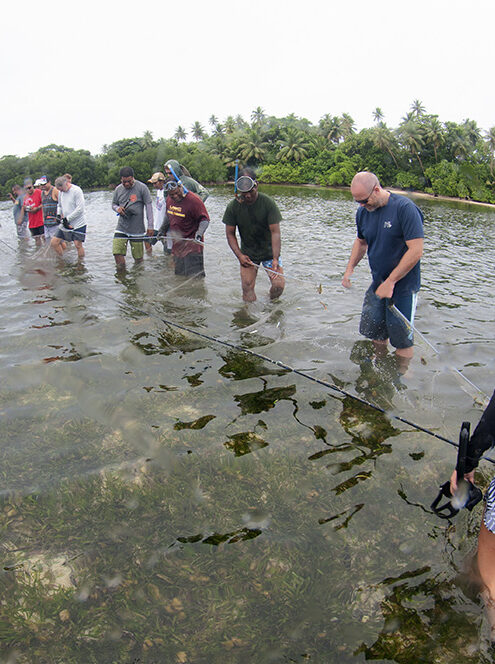
Rey Torres, a Tao County,
N.M., extension specialist, helped farm families who recently
formed a new wheat cooperative determine whether to diversify
into greenhouse vegetables for the fresh market. –
Photo by Jeff Caven |
 |
Once you’ve identified an objective, you can design an experiment
to collect the desired information. The best way to have faith in
your results is to design research plots that you can compare against
each other – again and again.
Each research experiment involves “treatments,” or
practices on different field plots designed to test your hypotheses.
Replicating your treatments – or repeating the same treatment
in the same field – will allow you to distinguish between
random variation in the system and the real effects of your work.
Analyzing data in a valid statistical manner is virtually impossible
without replicated treatments. Most scientists would advise at least
three replications.
Researchers also randomize treatments to eliminate any potential
bias that might exist in the system. For example, if organic matter
gradually increases from west to east across a field and a two-treatment
experiment is laid out in that field in a simple alternating pattern
from west to east – such as Plot A-Plot B-Plot A-Plot B –
each “B” treatment will have a built-in bias of more
organic matter compared to its corresponding “A” treatment.
Randomizing the pattern of replicated treatments will help eliminate
that bias. Randomize your treatments even if you do not see any
indication of differences in your fields.
While researchers use several different experimental designs for
field trials, on-farm researchers studying cropping systems typically
use either of the two shown below.
Randomized Complete Block Design
The most popular experimental design used for crop research, the
randomized complete block design, groups treatment plots together
and randomizes them within replicated blocks. The following example
shows how a trial testing three treatments of varying nitrogen rates
(0, 80 and 160 lbs/acre), each replicated three times, might be
laid out in a randomized complete block design.
For example, a farmer might apply commercial fertilizer at 80
pounds per acre in one plot, 160 pounds in another and none in a
third. The layout of plots in the field should be random.

Split-Plot Design
Another popular and useful design for on-farm researchers is the
split-plot design. This design allows you to test two different
factors and how they interact. For example, to determine how much
you can reduce nitrogen in corn following a hairy vetch cover crop,
the split-plot design could be used as follows: Set up the main
plots, each split into two treatments (vetch versus no vetch). Then
overlay each main plot with a second treatment (varying nitrogen
rates).
Such experimental designs are particularly well suited to farmers.
Treatments can be laid out in strips, with length of the plots determined
by the length of the field and the width by the equipment you use.
Applying Treatments and Collecting
Data
It is important to treat every plot exactly the same except for
that part that is intentionally varied – the treatments. Unintended
variation within your plots can occur from many sources. Moreover,
some variation can result from how treatments are applied and data
is collected.
In Illinois, for example, a crop farmer set up an on-farm research
project testing reduced rates of a herbicide mix on ridge-tilled
soybeans. He tested four application rates – full, three-quarters,
half and zero. He then used a standard randomized complete block
design, properly replicating each treatment. But he did one thing
wrong: He rotary-hoed all the zero-rate plots, but not any of the
others.
After the farmer introduced an element of variation to one treatment,
comparing the zero-rate plots to the other treatments was like comparing
the proverbial apples to oranges.
Data collection is another potential source for mistakes. Take
all measurements under the same conditions, using the same methods.
Be as uniform as possible when applying treatments and collecting
data. To analyze an experiment properly, you must have data from
each individual treatment plot. Averaging all the treatment “A”
plots and averaging all the treatment “B” plots will
not be usable for analysis.
Tips for crop researchers:
Keep
it simple, especially at first. Limit your project to a comparison
of two or three treatments. As you gain confidence, try something
a little more challenging.
Seek
help. Key times for professional assistance are at the design
stage and then again when analyzing your data.
Replicate
and randomize. Plan on enough field space to do more than one
strip of each treatment being tested. Mix treatments within blocks.
Stay
uniform. Treat all the plots exactly the same except for the differing
treatments. If possible, locate your experiment in a field of
uniform soil type.
Harvest
individual plots. Record data from each individual plot. Don’t
lump all treatment types together or you’ll lose the value
of replication.
Remain
objective. The results may not turn out as you hoped or planned.
Be prepared to accept and learn from negative results.
Repeat
the same research project multiple years. Climate is never the
same from year to year. Repeat your experiment until you are comfortable
with the results under varying conditions.
Don’t
ignore unexpected results. Sometimes, an experiment will generate
useful information outside your project parameters. Maybe you’ve
introduced a new legume to test animal weight gain after grazing,
but then find that your soil organic matter has increased. Unintended
findings like those could prove quite useful.
Manage
your time wisely. Expect to devote extra time to your research
during busy harvest seasons. Make sure you can carry out your
experiment or get extra help.
-- Dan Anderson, University of Illinois
Next
section
Top
|